_edited.png)

What Defines Quality in a Tripod Beta Investigation?
Updated: Jul 29
Many organisations apply Tripod Beta as part of their incident investigation process. The methodology provides a structured framework … yet the quality of the outcome still varies significantly in practice. A diagram can be complete … and still not tell you anything meaningful. An analysis can be structured … and still lack insight. What, then, defines a good Tripod Beta investigation?
Quality in Tripod Investigation: Looking Beyond the Diagram
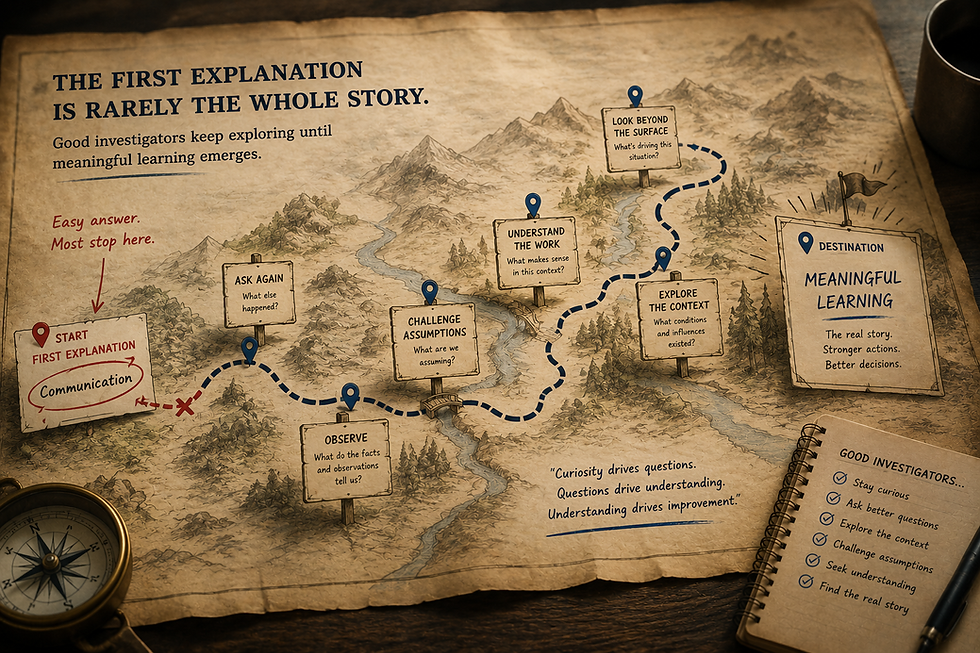
Tripod Beta offers a clear analytical structure. However, following the method's steps does not automatically result in a high-quality analysis. In practice, investigations sometimes become an exercise in completing the diagram. Boxes are filled, connections are made, and the structure appears complete … yet the analysis itself often remains superficial.
A complete analysis is not necessarily a meaningful analysis. Quality does not sit in the format … it sits in the thinking behind it.

Clarity of the Event and Context
A strong investigation starts with a clear and precise definition of the event. What exactly changed? Which object was affected? What was the role of the agent? These may seem like simple questions … yet this is where many analyses already start to lose sharpness.
If the change of state is not clearly defined, everything that follows becomes less precise. Barrier analysis becomes vague. Causal reasoning becomes inconsistent.
Clarity at the beginning determines the quality at the end.
Quality of Barrier Thinking
Barrier thinking is central to Tripod Beta … and at the same time one of the most misunderstood aspects of the methodology. Barriers are not simply physical objects, procedures or systems. They represent functions that control hazards or protect people, assets and the environment.
A good analysis focuses on whether that function was actually present, effective and reliable. It looks at how the barrier was designed, implemented and maintained … and why it did not perform as expected. Superficial barrier descriptions lead to superficial conclusions. Precise barrier thinking … changes the conversation entirely.
Understanding Human Behaviour
Tripod Beta does not treat human behaviour as the root cause of incidents. Instead, it looks at how behaviour is shaped by context. People generally act in ways that make sense to them at the time. The task, the environment, available information, constraints, and organisational conditions influence their actions. Looking back, it is easy to judge. Understanding why the action made sense in that moment … is something else.
A good investigation avoids hindsight bias and moves beyond simplistic explanations. It seeks to understand behaviour as an outcome of the system, not as a failure of the individual.
Depth of Underlying Causes
Underlying causes are often where analyses lose their strength. It is easy to write down "insufficient training" or "lack of communication"… but these rarely explain anything. They sound plausible … yet they do not provide a solid basis for improvement. High-quality Tripod Beta analyses go further. They identify specific, observable and explainable organisational factors. They show how these factors shaped the conditions in which the event occurred.
Depth requires precision. It requires moving beyond general statements … towards understanding how the organisation actually influences everyday work.
From Analysis to Learning
The purpose of an investigation is not the diagram itself. A good analysis creates a foundation for meaningful dialogue. It helps teams reflect on how work is really done, how risks are managed and where improvement is needed. This requires more than technical accuracy. It requires the ability to translate analysis into insight … and insight into action.
Quality Becomes Visible in the Thinking
A good Tripod Beta investigation is not defined by the completeness of its diagram … but by the quality of thinking behind it. It combines clarity of the event, precision in barrier thinking, a systemic understanding of human behaviour and well-founded underlying causes. When these elements come together, the methodology supports not only analysis … but genuine organisational learning.
"Good analyses are not measured by their complexity. They are measured by their ability to create understanding."
Continue Developing Your Investigation Capability
If you would like to continue developing your investigation capability, you may also be interested in:
Discover the knowledge, skills and mindset that enable investigators to conduct high-quality investigations and transform analysis into meaningful organisational learning.
What Makes a Good Incident Investigator?
Explore the qualities that distinguish capable investigators and learn why curiosity, interviewing skills and operational understanding matter just as much as methodology.
Common Tripod Beta Investigation Pitfalls
Learn about common pitfalls that reduce investigation quality and discover how disciplined thinking strengthens the application of Tripod Beta.


Comments