_edited.png)

Interviewing Witnesses After an Incident
Updated: Aug 7
Long before investigators analyse barriers, identify organisational influences or construct investigation diagrams, they first need to understand what happened through the people who were involved.
The quality of those conversations often determines the quality of the investigation itself. Even the most structured investigation methodology cannot compensate for poor interviewing.
Developing strong interviewing skills is therefore one of the most valuable investments an investigator can make.
Every Investigation Begins with a Conversation
Incident investigations are often associated with analytical methods, timelines and investigation diagrams. Yet none of these can compensate for incomplete, inaccurate or misunderstood information.
Investigations begin with conversations. If investigators fail to create openness, important operational details, contextual information and valuable learning opportunities may never surface.
In many investigations, the initial focus is on fact-finding. While establishing the facts is essential, meaningful organisational learning only begins when investigators move beyond what happened and seek to understand why the situation made sense to the people involved at the time.
That journey from facts to understanding is built on trust.
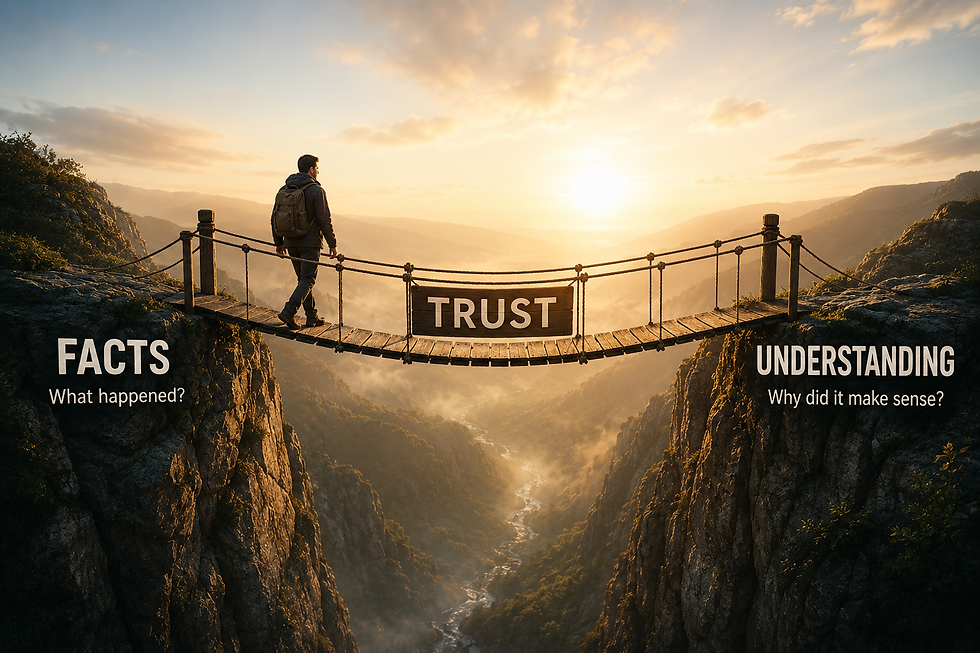
Psychological Safety Creates Better Information
People involved in incidents rarely enter an interview without concerns.
They may worry about:
blame
disciplinary consequences
disappointing colleagues
management reactions
damage to their reputation
These concerns naturally influence what people are willing to share.
Creating psychological safety does not mean avoiding difficult questions.
It means creating an environment in which people feel safe enough to answer them honestly.
The investigator's role is not to interrogate. It is to understand.
Open Questions Reveal Operational Reality
The way a question is asked often determines the quality of the answer. Leading questions can unintentionally steer people towards defending themselves.
For example: "Did you follow the procedure?"
Open questions allow people to reconstruct the event in their own words and may reveal information the investigator did not anticipate.
For example:
What made sense to you at the time?
What were you trying to achieve?
What challenges were you dealing with?
The skill lies less in using a fixed set of questions than in listening closely enough to recognise where a topic needs further exploration. Good investigators seek understanding before explanation.
Listening Is More Important Than Talking
Interviewing is often associated with asking good questions. In reality, experienced investigators usually spend more time listening than speaking.
They pay attention to:
hesitation
uncertainty
unexpected details
contradictions
changes in confidence
what is not being said
Silence is not something to avoid. It often creates the space people need to continue telling their story. Sometimes the most valuable insight emerges several minutes after the original question has been asked.
Choosing Between Individual and Group Interviews
Both interview formats have advantages. The interview setting influences what people feel able to share.
A conversation with a group may reveal how work is coordinated and understood collectively. A private conversation may create space to discuss information that is harder to address in front of colleagues.
There is no universally correct format. Choosing an appropriate setting requires judgement about the event, the people involved and the sensitivities surrounding it.
A Practical Example of Interviewing Skills
Following a maintenance incident, a technician initially explained that the task had been completed "as normal." Had the investigator accepted this answer, the interview would probably have ended within minutes.
Instead, the investigator remained curious. Rather than moving to the next question, they asked: "Can you show me how the task normally starts?"
As the conversation continued, the technician mentioned several interruptions during the work, uncertainty about the latest revision to the procedure, and increasing production pressure to restart the equipment quickly. Further discussion revealed that similar shortcuts had gradually become accepted within the team.
None of this information appeared in the initial explanation. It only surfaced because the investigator continued to listen, asked open questions, and allowed the story to unfold naturally.
Good interviews rarely produce immediate answers. They gradually reveal understanding.
Better Conversations Lead to Better Understanding
Interviewing is not simply about collecting information. It is about helping people reconstruct how the situation made sense to them at the time.
When investigators create trust, ask meaningful questions and genuinely listen, they uncover the operational realities that shape incidents.
Developing strong interviewing skills therefore means developing stronger investigators.
And stronger investigators create better investigations.
"People don't reveal the truth because they're asked.
They reveal it because they feel safe enough to share it."
Continue Developing Your Investigation Capability
Effective interviewing is one of the most valuable capabilities an investigator can develop. Strong conversations uncover the operational realities, organisational conditions and human factors that shape incidents and enable meaningful organisational learning.
If you would like to continue developing your investigation capability, you may also be interested in:
Discover the knowledge, skills and mindset that enable investigators to conduct higher-quality investigations through curiosity, critical thinking and effective communication.
What Makes a Good Incident Investigator? Explore the qualities that distinguish capable investigators and learn why interviewing skills are just one part of becoming an effective investigator.
The Problem with 'Human Error' Discover why understanding context, rather than simply identifying human error, leads to deeper insights and more effective organisational learning.
Tripod Beta Training Programme Explore our accredited learning events designed to strengthen investigation capability through practical learning, realistic case studies and continuous professional development.


Comments