_edited.png)

Barrier Thinking
Updated: Aug 7
Understanding How Systems Really Fail
Incident investigations often begin by asking what went wrong.
A procedure was not followed.
A valve was opened too early.
Someone made the wrong decision.
These observations may all be factually correct, yet they rarely explain why the incident became possible.
Barrier thinking starts somewhere else. Instead of asking "What failed?", it first asks:
"What should have protected the system?"
That seemingly small shift changes the entire investigation. Rather than concentrating primarily on the actions of the people involved, investigators begin by exploring how the organisation intended to control the hazard, how that protection performed in practice, and why it no longer provided the expected level of safety.
Barrier thinking therefore changes more than the analysis itself.
It changes the way investigators think.
Good Investigations Start with Protection
Every organisation relies on protection. Some of that protection is physical. Some is technical. Some depends on people. Together, these layers of protection are intended to prevent hazards from causing harm or to limit their consequences if something goes wrong.
When an incident occurs, our natural tendency is to focus on the point where things became visible:
the person who pressed the button.
the operator who entered the wrong area.
the technician who omitted a step.
Barrier thinking deliberately shifts the focus. Rather than beginning with the visible failure, it begins by understanding the protection that should have prevented the situation from developing in the first place.
That changes the questions investigators ask. Instead of asking: "Who made the mistake?"
they begin asking:
What protection should have prevented this situation?
How was that protection expected to work?
What happened to that protection?
These questions move the investigation away from individual actions and towards understanding how the system actually managed the hazard.
Protection Is More Than Procedures
Following an incident, organisations often identify opportunities to improve procedures, provide additional training or increase supervision. These are all valuable measures.
However, barrier thinking encourages investigators to look one step further. The important question is not simply whether these measures existed, but what protection they were intended to provide.
Consider a permit-to-work system.
The permit itself does not stop hazardous energy.
A procedure does not physically prevent equipment from starting.
Training does not automatically stop people making mistakes.
These measures help organisations manage risk. Their real value lies in how they contribute to protection that actually works when it is needed. This distinction is subtle but important.
Investigations that focus only on procedures often end with recommendations to improve compliance. Investigations that focus on protection ask a much more valuable question: "Was the organisation receiving the protection it believed it had?"
That question often reveals opportunities for learning that would otherwise remain hidden.
Evaluating Protection Instead of Compliance
Imagine an investigation into a maintenance incident involving hazardous energy.
One conclusion quickly emerges: The lock-out procedure was not followed correctly.
For many investigations, that appears to explain the incident.
Barrier thinking treats this as the starting point rather than the conclusion.
Instead of asking whether the procedure was followed, investigators ask a different question: "How was hazardous energy supposed to be prevented from reaching the workplace?"
Once the investigation focuses on protection rather than compliance, entirely different questions emerge.
Was the isolation independently verified?
Was the procedure practical to apply?
Were responsibilities clearly understood?
Was sufficient time available to perform the work safely?
Had workarounds gradually become accepted?
Did operational pressures influence the way the work was organised?
These questions rarely remove individual responsibility. But they often explain why the organisation's protection was no longer as effective as everyone believed. And that understanding provides a far stronger foundation for organisational learning than simply identifying procedural non-compliance.

Protection Gradually Becomes Weaker
One of the most valuable insights provided by barrier thinking is that protection rarely disappears overnight. In most organisations, barriers gradually become less effective.
Operational priorities change.
Equipment ages.
Temporary workarounds become accepted practice.
Maintenance is postponed.
Roles become less clear.
Individually, none of these developments may appear particularly significant. Collectively, however, they can slowly reduce the protection available to people performing the work.
By the time an incident finally occurs, the organisation may have been operating with weakened protection for months or even years without fully recognising it. Understanding how this gradual change developed is often where the most valuable learning begins.
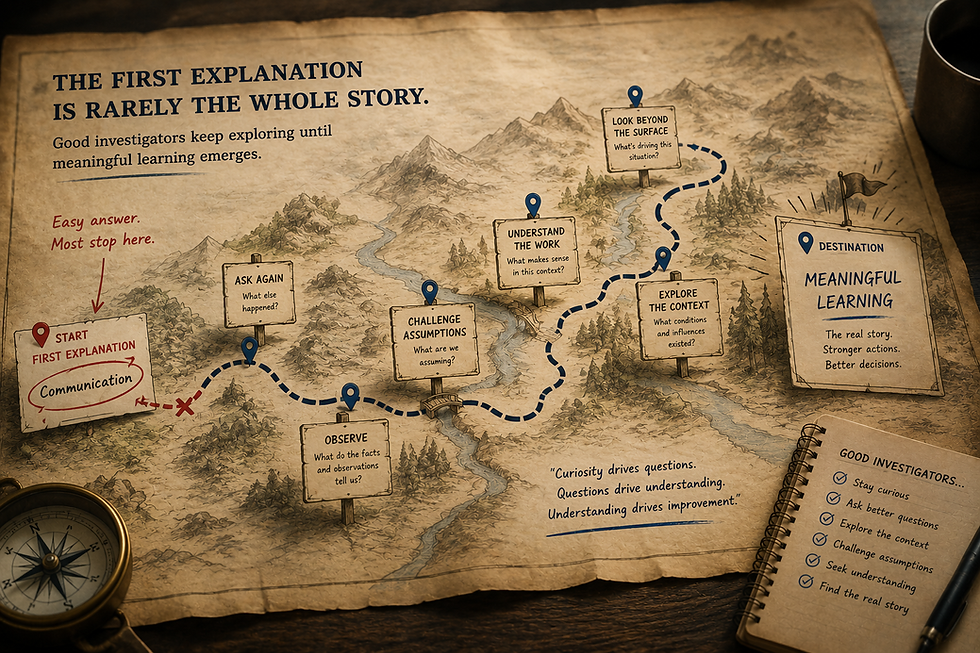
Better Questions Create Better Investigations
One of the greatest strengths of barrier thinking is that it changes the questions investigators ask. Rather than concentrating on the point at which the incident became visible, investigators begin by exploring how the organisation expected the hazard to remain under control throughout the work.
That subtle change in perspective often transforms the entire investigation.
Instead of asking:
Who made the mistake?
Why wasn't the procedure followed?
Which rule was broken?
Investigators begin asking:
How was this hazard intended to be controlled?
Which protection should have prevented the situation?
Was that protection available, reliable and effective?
What influenced its performance?
How had the level of protection changed over time?
These questions rarely produce simple answers. Instead, they reveal how operational reality, organisational decisions and everyday work interact to shape safety performance.
Rather than searching for someone to blame, investigators begin to understand how the organisation manages risk in practice. And that understanding creates opportunities for improvement that would otherwise remain hidden.
Barrier Thinking Supports Organisational Learning
The purpose of an incident investigation is not simply to explain what happened.
Its real value lies in helping organisations understand how similar events can be prevented in the future.
Barrier thinking supports this objective by directing attention towards the effectiveness of protection rather than the actions of individuals alone. It encourages organisations to reflect on questions such as:
Are we relying on protection that is weaker than we believe?
How do we know our barriers perform as intended?
What changes in the organisation could gradually reduce their effectiveness?
Where are we unknowingly accepting increasing levels of risk?
These are not only investigation questions. They are organisational learning questions.
Because every incident provides an opportunity to learn not only about the event itself but also about how the organisation controls its most significant hazards.
Protection Is Where Learning Begins
Barrier thinking is much more than identifying barriers within an investigation.
It is a different way of looking at incidents.
Instead of beginning with failure, it begins with protection. Instead of asking only what people did, it explores how the organisation intended to control the hazard and why that protection no longer performed as expected.
This perspective does not remove personal responsibility. It simply recognises that lasting improvements rarely come from understanding individual actions alone.
They come from understanding how protection is created, maintained, and sometimes gradually weakened over time.
Because organisations rarely become safer simply by identifying what went wrong.
They become safer by understanding what should have protected them in the first place.
"Good investigations don't start with failure.
They start with protection."
Continue Developing Your Investigation Capability
Barrier thinking helps investigators move beyond symptoms and towards understanding how organisations manage hazards through effective protection. Developing this perspective leads to stronger investigations, more meaningful learning and better-informed improvements.
If you would like to continue developing your investigation capability, you may also be interested in:
Learn more about the principles behind Tripod Beta and how the methodology helps investigators understand incidents through systemic thinking and barrier analysis.
What Defines Quality in a Tripod Beta Investigation?
Discover what distinguishes high-quality Tripod Beta investigations and why good analysis depends on much more than completing a diagram.
The Problem with 'Human Error'
Explore why human error is rarely a sufficient explanation and how looking beyond individual actions leads to deeper organisational learning.
Tripod Beta Training Programme
Develop your investigation capability through our accredited learning events, designed to strengthen practical investigation skills and the effective application of Tripod Beta.


Comments