_edited.png)

The Enduring Value of Tripod Beta
Updated: Aug 7
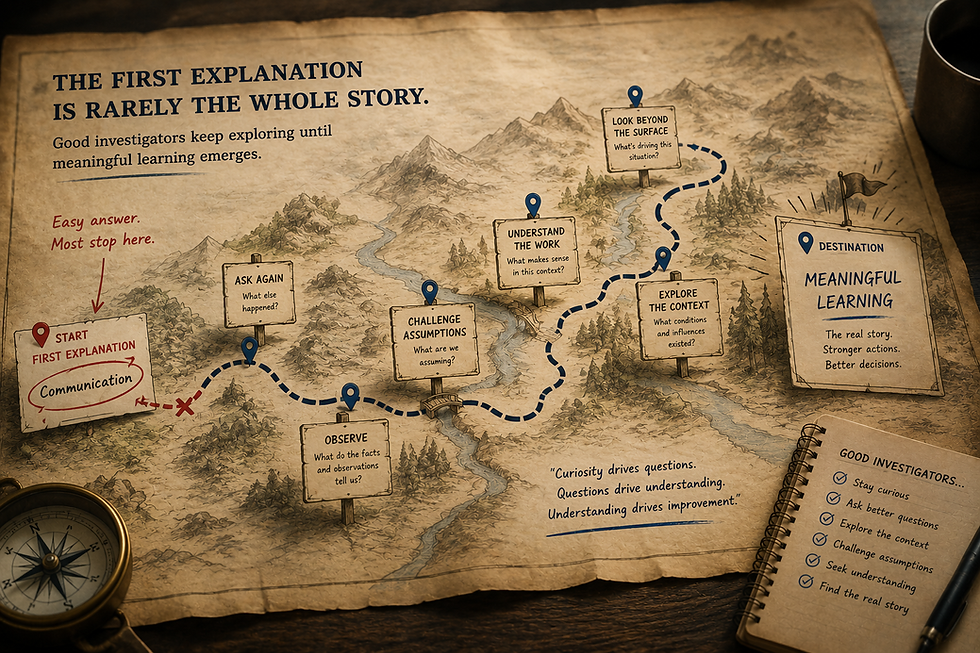
In high-risk and complex industries, organisations continue to seek investigation approaches that go beyond immediate causes and simplistic explanations of human error. While safety thinking has evolved significantly over the past decades, the need for structured, systemic analysis remains unchanged.
Tripod Beta, developed in the 1990s at the universities of Leiden and Manchester on behalf of Shell International, was designed to address this challenge precisely: to understand not only what happened but why events developed as they did within the organisational system.
The Enduring Value of Tripod Beta
More than thirty years after its development, the enduring value of Tripod Beta lies not in following trends, but in its ability to help investigators look beyond events and understand how barriers, human behaviour and organisational conditions interact over time.

From Barrier Failure to Systemic Understanding
At the heart of Tripod Beta lies barrier thinking.
Operations rely on barriers and organisational controls to prevent hazards from escalating into harm. Incidents occur when one or more of these barriers fail or are absent. However, barriers do not deteriorate in isolation. Design decisions, maintenance strategies, resource allocation, planning processes and everyday operational pressures shape their effectiveness.
Tripod Beta, therefore, examines not only which barriers failed but also the organisational conditions that weakened their effectiveness. This layered analysis enables investigators to move beyond surface explanations and explore how organisational factors influence risk control over time.
Beyond Human Error
Traditional investigations often conclude with “human error” as the primary cause. Tripod Beta deliberately moves beyond this framing.
Human behaviour is not treated as the root cause of incidents, but as the result of interacting organisational conditions. People generally act in ways that make sense within their local context. When something goes wrong, the more productive question is not “Who failed?”, but “What conditions made this action possible or likely?”
By analysing the organisational environment - including planning, communication, competence, supervision and management priorities - Tripod Beta supports a shift from blame-based thinking towards meaningful organisational learning.
Structure, Consistency and Transparency
A key strength of Tripod Beta is its structured analytical framework.
The methodology guides investigators through a disciplined process of identifying events, analysing barrier performance, defining immediate causes and exploring underlying organisational factors. The resulting visual analysis diagram provides a transparent representation of how the incident developed.
This structure strengthens consistency across investigations, supports defensible conclusions and enables comparison of patterns across multiple events. In complex organisations, such consistency is essential for credible learning.
From Methodology to Professional Practice
A structured method alone does not guarantee improved safety performance. Its value depends on the capability and judgement of those applying it.
Tripod Beta requires investigators to combine analytical discipline with contextual understanding. It demands careful reasoning, clear documentation and reflective dialogue within teams. When applied thoughtfully and consistently, the methodology becomes more than an analytical tool ... it becomes a shared language for understanding risk and improving organisational practice.
This combination of systemic thinking, barrier analysis and structured modelling helps explain the enduring value of Tripod Beta for organisations seeking meaningful learning from incidents. It provides not only a way to analyse events, but a framework for meaningful and professional learning from incidents.
"The strength of Tripod Beta is not the diagram.
It is the thinking the diagram enables."
Continue Developing Your Investigation Capability
If you would like to deepen your understanding of Tripod Beta and strengthen your investigation capability, you may also be interested in:
Learn more about the principles, structure and philosophy behind Tripod Beta, and discover why it remains one of the world's leading methodologies for incident investigation and organisational learning.
Explore the knowledge, skills and mindset that enable investigators to apply methodologies effectively and translate analysis into meaningful organisational learning.
What Makes a High-Quality Tripod Beta Investigation?
Discover the elements that distinguish high-quality Tripod Beta investigations and learn why the quality of thinking is just as important as the methodology itself.
Tripod Beta Training Programme
Explore our accredited learning events designed to help investigators build confidence in applying Tripod Beta through practical learning, continuous professional development and real-world application.


Comments