_edited.png)

Common Tripod Beta Investigation Pitfalls
Updated: Jul 29
Tripod Beta is a powerful investigation methodology, but like any methodology, its effectiveness largely depends on how it is applied.
Many weaknesses in Tripod Beta investigations are not caused by the methodology itself, but by the way investigators think, ask questions and interpret information.
Even experienced practitioners can unintentionally reduce the quality of their investigation by stopping their analysis too early, making assumptions, or focusing on classification before fully understanding the operational context.
Strong investigations therefore depend not only on understanding Tripod Beta, but also on developing disciplined investigation capability.
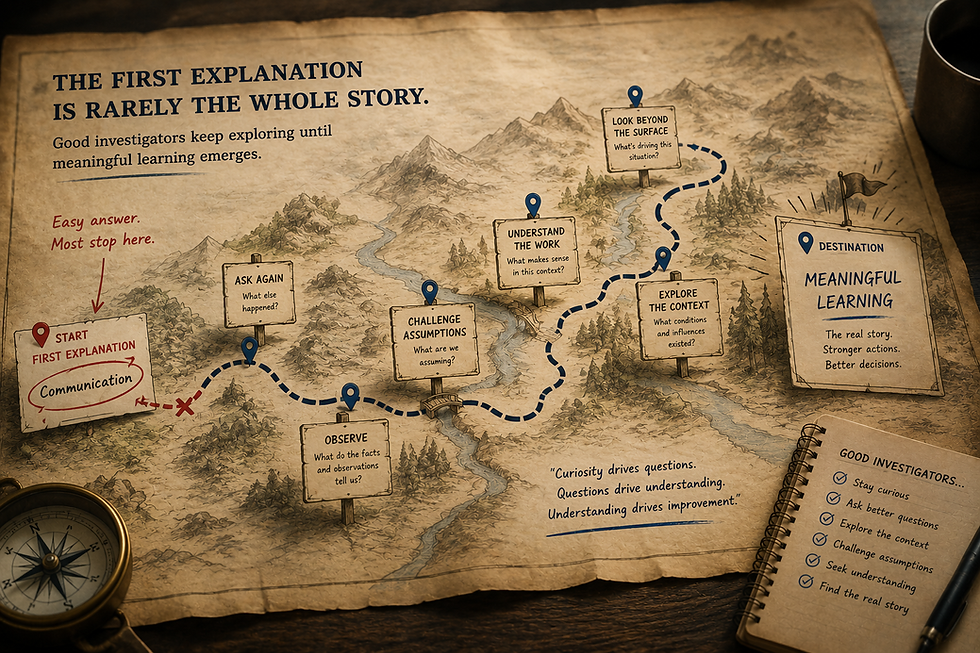
Investigation Quality Depends on More Than the Methodology
Tripod Beta provides an excellent framework for analysing incidents, but it does not automatically produce high-quality investigations.
The methodology guides the investigation, yet the investigator determines its quality.
Curiosity, operational understanding, careful questioning and disciplined thinking often make the difference between a superficial analysis and one that generates meaningful organisational learning.
Common Tripod Beta Investigation Pitfalls
Common Pitfall 1: Stopping at the First Explanation
One of the most common pitfalls in Tripod Beta investigations is accepting the first explanation that appears plausible. Investigators may quickly define Events, assign BRFs or identify apparent causes before fully exploring the operational context.
This often results in:
Weak Event definitions
Consequences being mixed into Events
BRFs being assigned too early
Missing Preconditions
Superficial organisational learning
Strong investigators continue asking questions long after the first explanation appears to make sense.
Common Pitfall 2: Letting Language Shape the Investigation
The language used during an investigation influences how people think about the event.
Judgemental expressions such as:
careless
failed to
ignored
negligence
should have
can unintentionally introduce blame into the investigation.
Neutral language encourages curiosity, supports psychological safety during interviews and helps investigators remain focused on understanding rather than judging.
Common Pitfall 3: Confusing Complexity with Quality
Large Tripod diagrams containing dozens of Events, Preconditions and BRFs do not automatically represent stronger investigations.
In fact, unnecessarily complex analyses often make it more difficult to understand how the incident developed.
Effective Tripod investigations remain:
logical
disciplined
transparent
easy to follow
Simplicity should never be confused with superficiality.
A Practical Example: Looking Beyond the First BRF
During an investigation into an equipment isolation incident, the investigator initially classified the issue under "Communication".
At first glance, the explanation seemed straightforward. Information had not been clearly transferred between the two teams. However, further interviews revealed that the communication breakdown was only one part of a much larger picture.
The investigation uncovered multiple Preconditions, including frequent interruptions during shift handovers, an isolation procedure that was difficult to follow in practice and increasing production pressures that had gradually normalised informal workarounds.
What initially appeared to be a communication issue ultimately reflected a combination of operational conditions, procedural weaknesses and organisational influences.
Without continuing beyond the first BRF, much of this valuable learning would have remained hidden.
Strong Tripod Beta Investigations Require Strong Investigators
Many common pitfalls in Tripod Beta investigations are not caused by the methodology itself. They arise when investigators stop exploring too early, rely on assumptions or focus more on completing the analysis than on understanding how the incident developed.
Developing capable investigators therefore requires more than learning the methodology. It requires practice, reflection, operational understanding and the ability to remain curious throughout the investigation process.
Ultimately, strong investigation capability is what transforms Tripod Beta from a powerful methodology into a powerful learning process.
"Curiosity drives better questions.
Better questions drive understanding.
Understanding drives improvement."
Continue Developing Your Investigation Capability
If you would like to continue developing your investigation capability, you may also be interested in:
Investigation Capability Discover what makes investigators effective and how strong investigation capability supports better investigations and meaningful organisational learning.
What Makes a Good Incident Investigator? Discover the qualities, mindset and behaviours that distinguish effective investigators from those who simply follow a methodology.
Training Calendar Explore upcoming accredited Tripod Beta Learning Events and find the next opportunity to continue your professional development.


Comments